The post On Security Tokens and Global Regulatory Risk appeared first on crowdfund.direct.
]]>The post On Security Tokens and Global Regulatory Risk appeared first on crowdfund.direct.
]]>The post A Value Proposition for Real Estate Tokenization appeared first on crowdfund.direct.
]]>DigiShares recognizes that fees can be a function of the complexity in running your investments, especially in real estate. Loosening of regulatory limits on private placements worldwide allows companies to take fund raising, management and liquidity provision for their stakeholders into their own hands. Our mission is to help you minimize the administrative costs associated with this, particularly automation of the back-end processes with added benefits being customization and infinite scale. By combining cutting-edge fintech infrastructure and blockchain enabled software, you can now fundraise easier, cheaper within the confines of single or multiple legal jurisdictions. Competitor low-touch technology solutions only provide piece-meal solutions for this. Here is a compact overview of real estate use cases for security tokens and how using the DigiShares platform in particular can save you money.
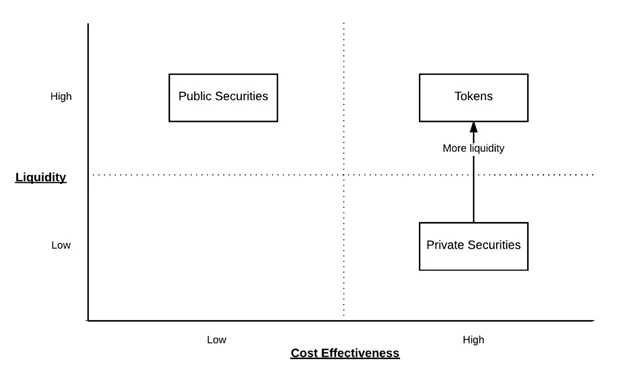
Liquidity vs Cost matrix for real-estate backed security tokens
1.LIQUIDITY INFRASTRUCTURE
How can security tokens improve liquidity for long duration private investments like real estate, private equity and venture portfolios? Blockchain is international, stock exchanges are national. Substantial capital is being deployed worldwide to establish digital exchanges of security tokens to bridge the two. Real life use-cases from low-touch crowdfunding platforms have already validated how fractionalization enhances liquidity within a closed system. Real estate will be the single largest use case for liquidity pools and help close the illiquidity premium gap through better valuation for the best projects. Our platform makes sure all our client tokens are “inter-operable”, allows to comply with different regulatory frameworks and can be offered at these exchange venues or more decentralizes market venues in the future, accounting for all KYC/AML ownership (incl. automatic rejection of certain countries) and payment details. A less expensive alternative solution is also provided, in a bulletin-board for buyers and sellers to self-clear transactions using an atomic swap within single projects investments. Instantaneous settlement, zero counter-party risk and immediate verification of on-chain ownership are unique features that traditional platform venues cannot offer. For private securities in general, there is often no way for custodians to settle transactions between their institutional customers, limiting institutional ownership of private assets. The bridge that we provide to a digital custodian should accelerate this demand for those that require an extra layer of third-party verification.
2.CORPORATE FINANCE
One of the unique features as a protocol agnostic security token platform is the flexibility to represent various parts of the capital stack like preferred equity and mezzanine loans that can appeal to accredited investors and family offices looking for “equity-like returns” within real estate financings. Flexibility on protocols allows for different classes of shares and other representations of the capital stack in the corporate management system. Cost effective structured-finance solutions can be tailored on a project-by-project basis for property owners – together with other stakeholders such as their real estate, mortgage bank and broker counterparts. Private loans that exist as pdf files can be replaced by digital records containing structured data. Debt token representations of real assets that represent the collateral in the commercial retail property can be easily transferred between commercial buyers and sellers, avoiding expensive title transfer fees. Mortgage banks can make better decisions on their commercial loan books by extracting real time loan repayment delays, rental, vacancy data by integrating with property management software vendors. In the same way tokens can be re-issued for loss, they can be a burden to dissolve a transaction and can also serve a more transitory purpose for intermediaries focused on transactions.
3.FRACTIONALIZATION
The use case for smaller lot-sizes goes beyond individual investing, as accredited investors and family offices looking for diversification can also allocate to medium size projects where illiquidity premiums are more present. For example, in the U.S, most tokenization of equity is done using Reg D 506 or Reg S with accredited investors. In some case, LPs within projects can use our platform to conduct their own syndication or sales efforts. Particularly Private Equity, could be a big beneficiary of this. Private REITs may choose to sell down certain commercial properties, while maintaining some ownership to get the full carry in an eventual sale of single property, meanwhile freeing up funds to invest in new projects. Green field projects with construction loan financings can take off some pressure on pre-sale, allowing for carry through the full sales cycle. Brown field projects that require modification or upgrades can sell some ownership to help fund large capital outlays without over-leverage. Institutional investment funds can use fractionalization to raise capital from outside the jurisdiction of the local project itself. Local financial institutions in many of the most developed emerging markets often have their own criteria – International guarantees can come at a high cost.
4. PAYMENTS
Working with leading payment infrastructure companies, our platform allows for interoperability between major currencies and stablecoins for our users, arbitrating away bank transactional fees. Your end clients will not notice the blockchain layer, as median of exchange can remain regular currency, meanwhile near 0 bank deposit fees will allow for more frequent smaller dividend payments and distributions. This takes away the transactional fee impediment to fractionalization, allowing you to focus on marketing effort instead. Without diving into too much explanation, using our omnibus wallet (virtual wallet within one large custodied wallet) to pool all token holders into one aggregated transaction fee, saves substantial costs. Established stock transfer companies charge $25 per single dividend payment. 1,000 investors receiving quarterly dividends equates to $100,000 USD slippage.
5. AUTOMATED COMPLIANCE
Private placement offerings that fall under certain regulatory exemptions, allow for exclusion of long-form prospectus, legal filing and audit fees. The largest administrative cost saving is custodial from self-administration of ownership transfers. Transfer agent fees will cost your business far more than a software subscription. Traditional roles of a transfer agent – recording transactions, canceling and issuing of certificates, processing investor mails and dealing with lost or stolen certificates can all be automated within the platform. This ability to self-administer is a game changer, although one may choose to use a third-party provider in a plug-and-play fashion, if a regulator or institutional investor requires it. Ongoing regulatory compliance costs associated with annual token holder meetings and tax compliance that comes from automated record keeping and audit standards can be substantial. Post-issuance corporate action management processes are included and dividend distribution and shareholder voting can be done at near zero cost. With blockchain, shareholder conflicts are avoided as all records are indisputable, limiting related legal fees. Personnel costs for legal counsel, investor communications and compliance processes alone that get allocated as part of management fees can easily reach $100,000 a year. Even on-line trading platforms charge outgoing stock transfer fees of $25-50/ISIN.
6.INTANGIBLE BENEFITS
On-chain verification of your ownership can be done with full privacy in mind. A platform administrator can maintain the individual token holders in an omnibus wallet with their digital custodian of choice. The omnibus address is verifiable on the public ledger and together with a separate 2 factor authentification log in to the platform client portal is the closest one can come to on demand certainty of ownership. In the event the client wants to self-custody, that can easily be done. It has no influence on the ability to cancel and re-issue tokens in the event they are lost or stolen. Smart contract automation also means option for error, loss of data on things that require “attention to detail” minimized and certainty of transactions are enhanced. Clients can be notified instantaneously of pertinent changes that may require their attention.
There is no concrete published data on this, but security tokenization has been estimated to provide upwards of 200bps of synergies for private placements of secondary home mortgage loans in the US:
– 100bps reduction in administrative, origination costs
– 100bps in liquidity premium benefits.
For private investment entities where dividends, revenue-streams, back-office reporting needs to be done at least a few times a year, we can apply the same value proposition rationale.
7FUTURE USECASES
Crypto itself is a property management system. But it has its best use cases on the back-end rather than the front-end. We hope our white-label can be gatewayed to help streamline the multiple categories of back-office functions by applying our customizable blockchain solutions to the best of fintech infrastructure that comes available. Areas of interests are ~ Registrar and transfer agency, fund accounting, middle office services, investor reporting, compliance services, front-office technology solution, financial statement preparation, management reporting, performance and attribution and risk reporting.
Contact DigiShares at info@digishares.io
Tokenize Your Real Estate
Many of our current projects are real estate tokenization projects, and for those of you who are specifically interested in real estate tokenization we have created a special page where you can learn about real estate tokenization and how to tokenize your project.
The post A Value Proposition for Real Estate Tokenization appeared first on crowdfund.direct.
]]>The post Security Token Exchanges 2021 appeared first on crowdfund.direct.
]]>Note that this list is incomplete and that some of the services may not be fully operational as of yet. All information contained in the list has been obtained exclusively from publicly available sources (e.g. company websites, national authority registers, news articles, etc.).
Apart from the name, type and website of the STO exchange, the list provides information on the status and scope of regulatory approvals in the exchanges’ respective jurisdictions. Included you will also find links to the financial licenses of the respective STO exchange, the specific registered activities (e.g. brokerage services, operation of MTFs, etc.), permitted and/or targeted customers. Some STO exchanges have affiliate or subsidiary companies that have the appropriate financial licenses, these are also identified where such information is publicly available.
Generally, an STO exchange must obtain appropriate financial licenses in its jurisdiction (e.g. broker-dealer license in the US, investment firm license in the EU) and ensure that the scope of its activities complies with the authorised activities under its financial license.
Definitions
MIFID II – the Markets in Financial Instruments Directive II is a legislative framework instituted by the European Union (EU) to regulate financial markets in the bloc and improve protections for investors. Its aim is to standardize practices across the EU and restore confidence in the industry. With the recent proposed amendments, security token offerings will be falling under the definition of “financial instrument” and, thus, will be subject to regulatory protection afforded under MIFID II.
Multilateral Trading Facility – a multilateral trading facility (MTF) is a MIFID II term for a trading system that facilitates the exchange of financial instruments between multiple parties. Multilateral trading facilities allow eligible contract participants to gather and transfer a variety of securities, especially instruments that may not have an official market. These facilities are often electronic systems controlled by approved market operators or larger investment banks. Traders usually submit orders electronically, where a matching software engine pairs buyers with sellers, learn more here.
OTC Services – over-the-counter marketplaces in which market participants trade stocks, commodities, currencies, or other instruments directly between two parties and without a central exchange or broker.
DEX – decentralized exchanges allow for direct peer-to-peer transactions to take place online securely and without the need for an intermediary.
Investment Firm License – MIFID II covers all natural and legal persons who perform investment services and activities (e.g. advice, execution of orders, market making, operation of trading facilities, etc.) using financial instruments, as a regular occupation or business, and on professional basis. Where a person meets the criteria and is not otherwise exempt from MIFID II, it will require authorisation as an investment firm with its respective competent national authority.
STO Exchanges 2021 List Below
| Security Token Exchanges | Jurisdiction | Licenses / Registrations | Registered Activities | Customers | Investment Types | Service Type |
|---|---|---|---|---|---|---|
| Archax Ltd | United Kingdom | Registered Crypto Asset Firm with FCA | Arranging investment deals Arranging safeguarding and administration of assets Dealing in investments as agents Operating a Multilateral Trading Facility (MTF) | Professional Institutional (Eligible Counterparty) Issuers | Tokenized shares, warrants, certificate representations of securities, debenture, rights to or interests in investments | Multilateral Trading Facility |
| BlockTrade | Liechtenstein Lithuania | MiFID II investment firm license application with FMA TT Service Provider with FMA Virtual Asset Service Provider Electronic Money Institution under responsibility of UAB Payrnet (Lithuanian EMI) | Operating a Multilateral Trading Facility (MTF) Brokerage services Virtual Currency Exchange Service Virtual Currency Wallet Service Distribution and redemption of electronic money Not issuance Provision of payment services under UAB Payment | Professional Institutional | Security Tokens | Multilateral Trading Facility |
| BNKtotheFUTURE | Cayman Islands USA (New York) | Broker-Dealer License with SEC Self-Regulatory Organisation under FINRA | Private placement of securities Underwriter or selling group participant (corporate securities other than mutual funds) Advisory Mergers and Acquisitions (M&A) Strategic planning and related services | Professional Institutional | Tokenized shares, warrants, certificate representations of securities, debenture, rights to or interests in investments | Over-the-counter (OTC) Services |
| Coinmetro | Estonia Montenegro | Virtual Asset Service Provider Registered Money Service Business with US Financial Crime Enforcement Network (Reg. nr. 31000150787900) Electronic Money Institution Application in the UK Participant in regulatory sandbox Multilateral trading facility license Central Securities Depository | Virtual Currency Exchange Service Virtual Currency Wallet Service Operating an MTF Operating a Central Securities Depository (CSD) | Retail Professional | Multilateral Trading Facility | |
| Polybird | USA (Delaware) | Broker-Dealer License Self-Regulatory Organization under FINRA | Operation of alternative trading system | Retail Professional Institutional | Commercial Real Estate Equities Bonds Digital Securities Intellectual Property | Over-the-counter (OTC) Services |
| Smart Valor | Liechtenstein Swizerland | Multilateral Trading Facility Application TT Service Provider Financial Intermediary under Swiss FINMA Fund Manager License Swiss FINMA | Operation of Multilateral Trading Facility | Retail Professional | Tokenized real assets Non-fungible tokens (NFTs) | Over-the-counter (OTC) Services Non-Fungible Token (NFT) marketplace |
| Openfinance Securities LLC | USA (New York) | Broker-dealer License Self-Regulatory Organization FINRA | Broker-dealer retailing corporate equity securities over the counter (OTC) Private placement of securities Broker-dealer operating an alternative trading system (CFX Markets, Openfinance network) Offering and engaging in online trading | Retail Professional Institutional Issuers | Real Estate Venture Capital Private Equity Real Assets Hedge Funds | Over-the-counter (OTC) Services |
| Templum Inc | USA (New York) | Broker-dealer License Self-Regulatory Organization FINRA | Broker-dealer retailing corporate equity securities over the counter (OTC) Mutual fund retailer Non-exchange member arranging for transactions in listed securities by exchange member Private placement of securities Private placement through online methods (excluding publicly traded securities) Operation of an alternative trading system for unregistered or private securities, including initial coin offerings (ICOs) and other digital securities | Professional Institutional Issuers | Tokenized securities and digital assets | Over-the-counter (OTC) Services Other |
| Atlant | United Kingdom British Virgin Islands | Unregistered (not on FCA registry) | NA | Retail Professional Institutional | Real Estate | Multilateral Trading Facility |
| NXchange | Netherlands | Investment Firm License License to operate or hold a regulated market with AFM Multilateral trading facility License | Operation of Multilateral Trading Facility | Retail Professional | Tokenized securities and digital assets | Multilateral Trading Facility Decentralized Exchange (DEX) |
| RealToken Inc | USA (Delaware) | Unregistered Exception under US Securities Act Regulation D – only offering to US accredited investors Exception under US Securities Act Regulation S – offering to non-US persons | NA | Retail Professional (for US only accredited investors) | Real Estate | OTC Services Decentralized Exchange (DEX) – partnership with uniswap.io |
| INX Limited | Gibraltar USA (Delaware) | Broker-dealer license (pending) Registered Money Transmitter with US Financial Crime Enforcement Network (Reg. nr. 31000178696348) | Operation of Alternative Trading System (pending) Cryptocurrency trading Other | Retail Institutional | Tokenized securities and digital assets | Multilateral Trading Facility / Alternative Trading System |
The post Security Token Exchanges 2021 appeared first on crowdfund.direct.
]]>The post Asset Tokenization on the Blockchain appeared first on crowdfund.direct.
]]>Contents:
(1) Real asset Tokenization – Why?
(2) The DigiShares Platform
(3) Real Asset Tokenization Processes
Many real assets have been tokenized until now, including real estate, mining operations, renewables projects, beverage distilleries, sports royalties, infrastructure, expensive objects of art, etc., etc.
1.Real Asset Tokenization – Why?
At the time of writing, the financial industry is seeing a very significant trend in the growth of tokenization projects and tokenization solution and services providers. DigiShares provides a primary issuance platform that supports ongoing corporate management of the real asset, as well as trading via the built-in OTC marketplace.
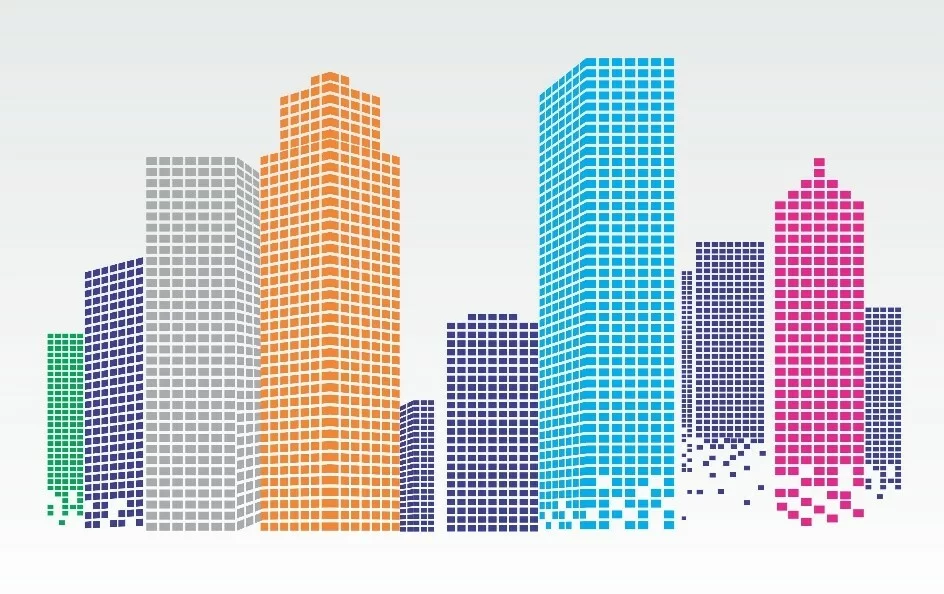
Other companies provide secondary trading exchanges for security tokens, custody solutions, legal services, etc. Many different pieces of the security token puzzle are now falling into place to form a more efficient, transparent, and secure blockchain-based infrastructure for securities transfer, settlement and trading.
Real assets including real estate is the biggest single asset class where tokenization can provide value – more than $200 trillion in total assets. Real assets share the value proposition of the overall securities market. We view some of the biggest benefits to real asset tokenization to be the ability to reduce ticket sizes by several orders of magnitude (from USD 100,000 to USD 1,000). This is made possible by the extreme automation of issuance and post-issuance processes, and it will dramatically increase the group of investors able to invest in a given fund. Another significant benefit is the new liquidity of real assets by making them tradeable. This will increase the amount of money available to invest in real assets, and on the other hand, will make the asset class more interesting for investors.
Real assets have some properties that lend themselves nicely to STOs – such as being relatively secure investments, requiring significant investment sums, being relatively easily comparable and quantifiable, as well as being notoriously illiquid investments. Real assets will as such benefit from the “standard” blockchain value properties such as: (1) the ability to automate and reduce the cost of issuance, transfer, settlement and trading processes, (2) the ability to automate and reduce the cost of governance processes such as cross-border transfers, cross-investor-type trading, lock-up periods, caps on investor counts, etc., (3) the subsequent increased ability to engage foreign investors and larger numbers of (smaller) investors thereby increasing the pool of investors for any given project, (4) the ability to reduce or remove different types of intermediaries such as CSDs, transfer agencies, broker-dealers, etc. due to the blockchain trust layer thereby increasing efficiency and reducing cost further, (5) the increased ability to attract investors due to the previously mentioned benefits (additional liquidity), and (6) the ability to significantly reduce ticket size of investors by an order of magnitude to cater for retail investors due to the automation of processes.
We will therefore see that good projects can raise capital easier, faster and at a reduced cost, investors will enjoy increased liquidity on their investments, good projects will get a liquidity premium, and investors will globally get access to previously inaccessible types of investments.
For some years now crowd-funding platforms have offered access to invest and trade “digitized” various real assets (primarily real estate). Why is tokenization better? For two main reasons. The “old” crowd-funding platforms are siloed and not interoperable globally. The global tokenization industry will use the same standards such that tokenization platforms on different continents will be inter-operable. This means that real assets issued by DigiShares will be tradeable on exchanges in the US, Europe and Asia. It also means that tokens issued by DigiShares can be kept in safe custody by most security token custodians globally. Finally, it means that no investors or issuers will be locked into a single vendor’s ecosystem but will be able to transfer their tokens for trading or custody to any other vendor globally (only limited by regulatory restrictions). The other reason is that blockchain technology is a much more modern, secure and efficient method for implementing securities transfer, settlement and trading compared to proprietary digitization of securities.
Further reading:
DigiShares real estate blog articles.
DigiShares CEO presentation on real estate tokenization.
Tokenized Securities & Commercial Real Estate.
2.The DigiShares Platform
DigiShares provides a white-label platform for digitizing securities (shares, bonds, etc.), issuing these in order to raise funds for a project, longer-term management of a group of tokenized investors, and an OTC marketplace for trading of these. The DigiShares platform is “white-label” meaning that it is exclusively sold to partners who offer the platform under their own brand-name.
The DigiShares platform can be used in connection with fund-raising but it can also be used in connection with the tokenization of existing real estate funds, in order to create more liquidity among existing investors and make it easier to on-board new investors.
The DigiShares platform provides a lot of functionality, however, the most important to mention is that it supports three main processes: (1) the issuance process where tokenized securities are issued in order to fund-raise for the project, (2) the longer term management of a group of investors who are holding tokens to document their ownership of securities within the project, and (3) the trading of tokens via the built-in OTC marketplace.
For the issuance process we support a customized on-boarding process where KYC and AML options can be adjusted to the specific jurisdiction of issuer and investors.
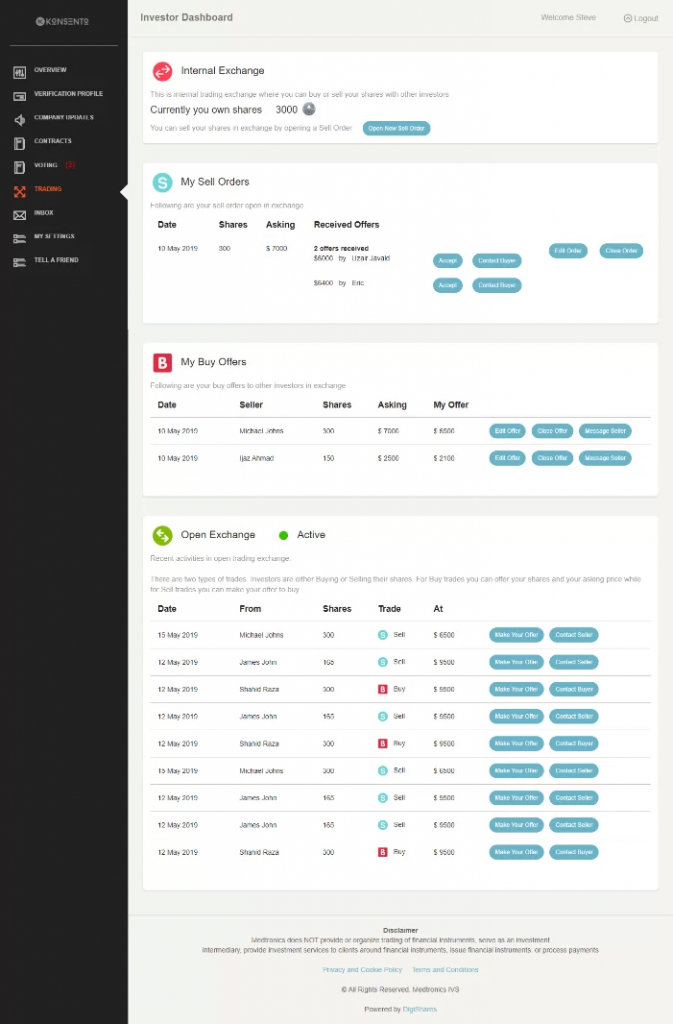
The investor has his own dashboard where he can view his token holdings, communicate with the issuer, vote on relevant issues such as how to renovate a building, purchase more tokens, etc. The issuer has a dashboard where he can verify investor provided KYC documentation and approve investors to participate in the STO. Once the investor is approved, he can buy tokens with various payment options. The solution has an e-signature module such that the contract workflow can be automated and digitized as much as possible. The KYC verification process can be handled internally or outsourced to a third party.
For the management of token holders over the longer term, many functions are provided to ensure communication with investors, to conduct token holder (shareholder) meetings, to conduct votes, pay out dividends (possibly with stablecoins), maintain the share cap table (shareholder register), etc. In addition, the solution supports various corporate actions giving the administrator (normally a top executive of the issuer) the right to forcefully transfer tokens from one investor to another, or back to the company – and to reissue tokens in case an investor lost access to them.
The platform also provides an internal OTC-like (Over The Counter) trading exchange. This means that existing investors within a project can trade tokens with each other. They can issue buy and sell orders and can match these on their own in a manual manner. It is also possible for new investors to be white-listed and invited into the exchange such that they can buy tokens from the old investors. This function provides increased liquidity within a single project and will provide an extra value for investors.
The platform is “multi-STO” meaning that it can handle multiple STOs in parallel, at the same time. Each STO can have its own URL for investor on-boarding and will have its own graphical content, presentation and content. This makes it possible for the real estate developer to have several ongoing real estate projects being active simultaneously in the platform.
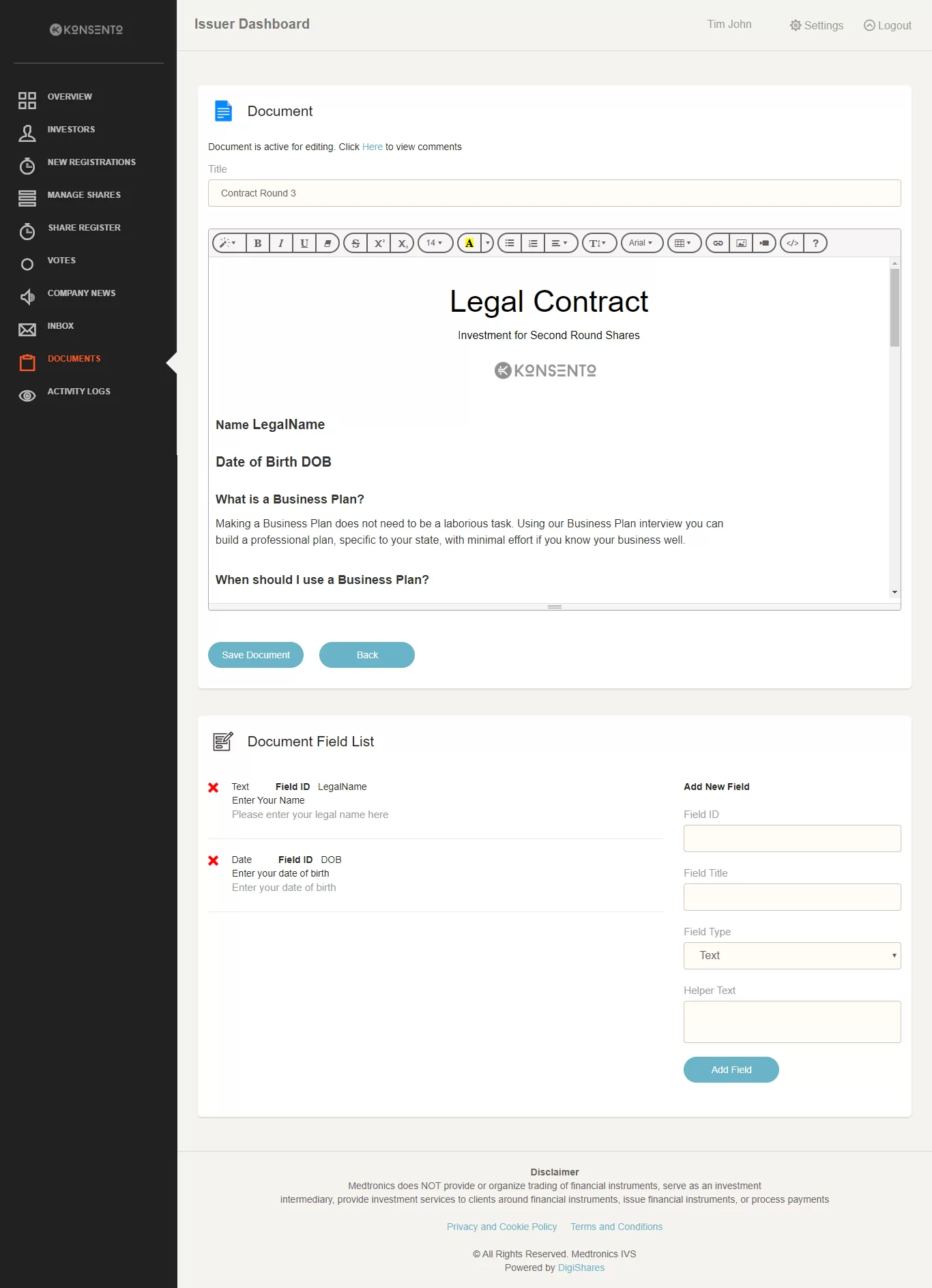
The platform is increasingly integrated with payment providers, custodians and third-party KYC / AML providers.
The DigiShares platform is highly suitable for real asset tokenization as it allows the issuer to manage and automate many of the processes related to fund-raising and ongoing fund management. The platform works with different security token protocols and we prefer to work with those that are open and do not enforce any kind of vendor lock-in.
While DigiShares is “bullish” on real asset tokenization, we do realize and acknowledge that not all investors understand and accept blockchain and indeed are prepared to hold a security token in a crypto wallet. For these investors we cater in two ways, one is by working with custodians who can hold the tokens for these investors (at a cost), the second is by enabling the platform to also support non-tokenized investors, that is, investors that do not receive tokens to represent their ownership but rather are registered within the platform as normal/traditional investors.
The DigiShares platform is constantly being updated in order to reflect changing and evolving market needs and the agile approach of DigiShares help our clients to stay up to date and relevant.
3.Real Asset Tokenization Processes
So how does one go about tokenizing a property? Either to raise funds for a new development project, or to sell an existing property?
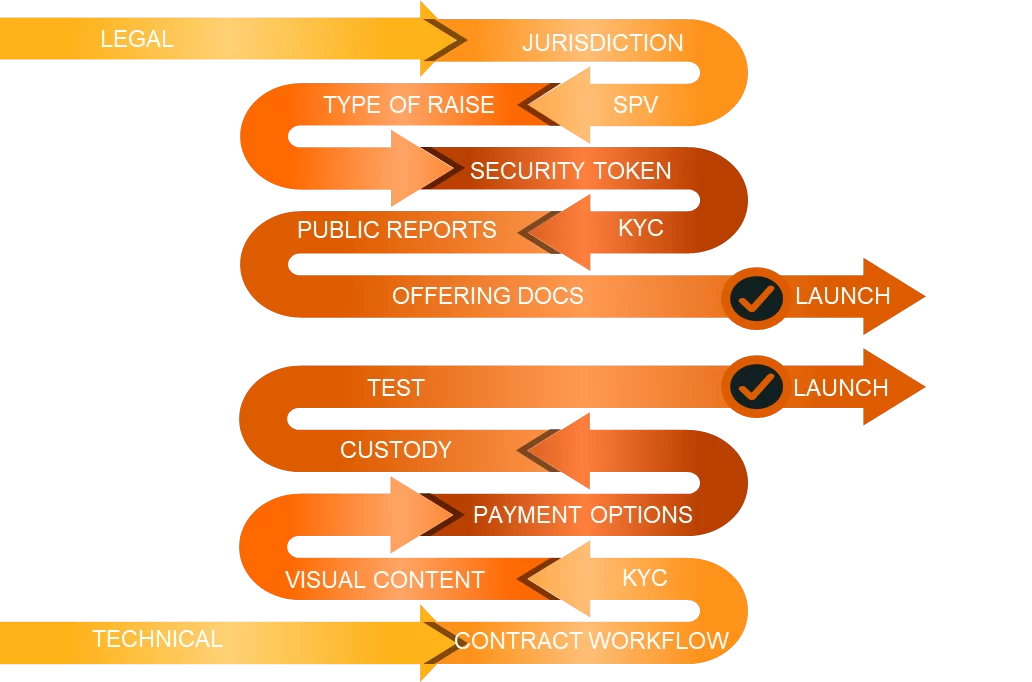
When a client engages DigiShares in this process, we also involve our legal partner in order to help with legal matters in relation to the issuance. As such, two processes start and run in parallel, the legal and the technical processes. (It is also possible to work with the client’s internal legal department or legal partner if they are sufficiently knowledgeable in STO regulations).
For any project one of the initial steps will be to create a project plan / roadmap for both the legal and technical work.
The legal process:
1) Deciding on jurisdiction for the projects. Tokenization projects fall under standard securities regulation and are as such indirectly supported in many countries. However, many countries do not support the full digitization of securities such as shares and bonds due to requirements for notarized transfers, paper-based ownership certificates, etc. Other countries are unclear on regulations so far. DigiShares and our legal partners keep track of regulatory developments and can at any time recommend best options, optimizing cost and regulatory complexity, while at the same time catering to investors in one of the three main regions (USA, Europe and Asia). We will be able to provide a recommendation for countries that support tokenized securities – or in case these are not supported, simplified types of securities such as profit-sharing rights or debentures that may more easily be tokenized.
2) Once a jurisdiction has been selected, the legal unit (the SPV = Special Purpose Vehicle) should be created and a bank account obtained.
3) Designing the fund-raise itself, based on amount to be raised and type of investors that are targeted. Together with our legal partners we can give recommendations on this. In the US, if the amount is above 1 M USD (as is almost always the case), it is relatively straightforward to conduct an STO under the reg D exemption where only accredited investors can be targeted. In Europe, there are more choices. If less than 5-8 M euro is raised, it is possible to make a public offering towards retail investors in many European countries. If the amount is above 5-8 M euro, it is normally necessary to get a prospectus approved which is a more costly and time-consuming process. For more insight, please click here.
4) Design the security to be tokenized. For real estate this is typically a share in the company owning and administrating the property, but it can also be a tokenized loan, profit-sharing right, dividend-distribution right, etc.
5) Designing the KYC (Know Your Customer) process for on-boarding investors. Together with the legal advisor, it is necessary to determine what information must be provided by investors in order to document their ID and address, for retail and accredited investors, and for consumer and business entities. Verifying the ultimate beneficial owner for a company may be quite complicated and time-consuming, so it is best to require of the investor to provide all relevant information when registering.
6) Reviewing and determining what kind of reports and updates have to be made to public transfer agencies, CSDs, etc. These can be generated as custom reports from the platform.
7) Depending on the type of raise, different types of legal documents need to be produced, such as either a private placement memorandum, a public offering memorandum, a regulation D filing form, a US or EU prospectus, etc.
The technical process:
1) Customizing the KYC process based on the input from the legal process.
2) Customizing the contract workflow deciding which contracts need to be used for the signing up of investors and subsequent token purchase, such as subscription forms, purchase receipts, shareholder agreements, etc. The goal is to automate the contract workflow as much as possible.
3) Customizing the content and information available to attractively present the property, including photos, financials, etc.
4) Customizing payment options including credit card payment, bank transfer and crypto payment. Again, the goal is full automation but this may require banking integration which can be time-consuming and expensive.
5) Customizing custody options – either with integrated custody partners or just by setting up agreements to custody investor tokens, paid and managed by either the issuer or the investors on their own.
6) Installing and customizing server software and training the issuer administrators in using the software platform.
7) Testing that everything is ready for the STO launch.
8) Pushing the “start” button and launching the STO.
9) A normal STO will typically last for 2-3 months.
In addition to the above workflows, there are also workflows relating to marketing and investor relations that DigiShares can also support. DigiShares is connected to both marketing agencies and investor relations services providers world-wide that are experienced in assisting with fund-raising for real asset projects.
For more information, please contact DigiShares at info@digishares.io
The post Asset Tokenization on the Blockchain appeared first on crowdfund.direct.
]]>The post Real Estate Tokenization Explained appeared first on crowdfund.direct.
]]>Tokenization is the concept of representing the ownership of securities (company equity, bonds, etc.) as tokens on the blockchain. These tokens are called security tokens, tokenized securities, or increasingly digital assets or digital securities.
Real estate is the single biggest asset class that may be tokenized. Total real estate is worth around $228 trillion today and only 7% of this is available to retail investors. However, more than 80% of people believe real estate to be a good investment. DigiShares aims to help close this gap.
The blockchain itself is a global network that allows individuals and business entities to transact directly with each other in an efficient and inexpensive manner, without using intermediaries as banks and notaries. With tokenization, real estate assets can be represented as tokens on the blockchain that will become as efficient and inexpensive to issue, transfer and trade as other cryptocurrencies.
Tokens on the blockchain can be self-custodied. This means that investors can safekeep their own assets in their own wallet (similar to a bank account on your mobile device or computer). Or they can choose a custodian to safekeep their assets. Custodians are like banks as they provide safe and insured storage of digital assets. However, they are compatible with the blockchain, provide APIs, and are generally quite inexpensive.
Tokens on the blockchain can also be transferred and traded in a peer-to-peer fashion. This means that any investor can directly transfer or trade with any other investor. The transaction itself does not need to be mediated by any middleman (bank, CSD, notary, etc.) but the blockchain itself makes sure that the transaction is settled correctly. The blockchain can even remove any counterparty risk, something that normally requires an expensive intermediary, such as an escrow account with a lawyer. The direct trading removes a lot of friction and makes securities processing on the blockchain highly secure, efficient and inexpensive.

Real estate is highly illiquid but through tokenization, it becomes possible to directly transfer and trade real estate assets to other investors in a very inexpensive and efficient manner. Platforms such as the one provided by DigiShares make this possible and maintains a fully updated share cap table at all times.
Real estate processes are also traditionally very cumbersome and paper-based, involving a lot of manual steps with banks, notaries, etc. With blockchain-based processing of real estate assets, it becomes possible to digitize and automate many of these processes to a much higher degree. With a platform such as the one from DigiShares, these processes can be fully automated:
– Registration of new investors and collection of required information. The actual verification of this can be outsourced to a third-party KYC provider for USD 2-3 per check
– Purchase of shares and investment into the property. The purchase process can be fully automated, allowing the transaction to occur with no manual processing at all. The share cap table is automatically updated after the purchase is completed
– Payment of dividends and interest. By clicking a single button, it becomes possible to pay out to all investors at once, based on a predefined allocation formula
– Trading of digital assets. DigiShares provides a built-in OTC marketplace where investors can trade with each other. No manual processing or participation from the real estate administrator is required.
The very high degree of automation makes it possible to have hundreds of investors in real estate projects unlike today where the number of investors is often limited to below 10. This in turn makes it possible to “fractionalize” and allow investors to participate with $1,000 or $10,000 size investments.
Only a few “accredited” investors may have the normally required $100,000 or EUR 100,000 to invest into a real estate project, but many more investors may have $10,000 or EUR 10,000 to participate. This opens up the market to new types of investors for the real estate developers and it will become easier to finance good projects.
It also allows a much higher percentage of the population to participate in real estate investments and develop a more professional investment strategy to diversify and protect their savings over the years. This is called “democratization” of real estate.
With the DigiShares white-label platform, real estate developers will get a structured platform that enables them to expedite and manage processes related to financing, refinancing, or selling real estate development projects. In addition, they will be able to efficiently and consistently manage a group of owners of a specific project with all that entails – the maintenance of the share cap table, the facilitation of shareholder meetings, the payment of dividends or interest, and the reissuance of lost tokens, etc.
If you are interested in learning more, please contact DigiShares at info@digishares.io
The post Real Estate Tokenization Explained appeared first on crowdfund.direct.
]]>The post Q&A with Polymath & DigiShares CEO appeared first on crowdfund.direct.
]]>Tokenization has the potential to unlock trillions of dollars in liquidity, in part by bringing thousands of ordinary traders to assets typically reserved for big-money investors. But with such great potential comes the need for the right technologies and regulatory approach to enable greater adoption of security tokens. Tools need to take full advantage of blockchain digitization and automation in ways that are compliant with legislation.

Polymath (P): What are the missing pieces needed to bridge traditional finance and blockchain technology?
Claus Skaaning (CS): I actually believe the pieces are falling into place. 2020 has seen massive interest in digital assets from issuers, and I expect that 2021 will see a massive increase in tokenization projects. One of the missing pieces has been regulation. Now we’re seeing more and more jurisdictions clarifying legislation related to tokenization, adopting the stance that a “tokenized security” is just a digital security that exists as a token on the blockchain. They’re also recognizing that tokenization can be handled not by adding new legislation but by slightly modifying and updating existing legislation to support digitized processes and documents.Also, we’re increasingly seeing banks interested in what we’re doing. Swiss banks are now becoming digital asset custodians and the first Swiss bank has announced their own tokenization platform. Some digital asset custodians are extending their services to cover fiat, essentially becoming neobanks. All of this makes it easier for investors to be onboarded into the world of digital assets.
P: What are the business benefits of using blockchain to issue securities and manage cap tables over traditional methods?
CS: Blockchain digitizes and automates processes related to issuance, governance, compliance, and trading to a much higher degree than we see today–which yields major efficiency improvements and cost reductions.These benefits suddenly make it cost-efficient and realistic to accept 10,000 investors into a real estate project instead of just 10 or 100, and to offer these 10,000 investors the ability to trade digital assets peer-to-peer. That just isn’t possible without blockchain technology.Cap table management benefits as well. Because the cap table is read directly off the blockchain, it can be kept up-to-date and doesn’t need to be manually updated or maintained. Even when trades are done peer-to-peer, the built-in smart contracts can automatically update the cap table.
P: What makes large physical assets (real estate, infrastructure, solar, wind, etc.) ideal for tokenization?
CS: They represent one of the largest single asset classes suitable for tokenization. Global real estate is worth $228 trillion and only 7% of that is available for retail investment, whereas more than 80% of investors view real estate as a good investment. Tokenization could help to close that gap.Insurance and the ongoing corporate management of these types of assets are traditionally paper-based, time-consuming and inefficient. There’s a lot of potential for digitization and automation. Also, these assets are very illiquid as there are very few, if any, efficient ways to trade them, whereas tokenization enables peer-to-peer trading in a very cost-efficient manner.
P: Real estate is the largest physical asset category right now. How do you envision tokenization changing the market over the next 10 years?
CS: Real estate will become much more accessible for retail investors than it is today. Today real estate investment is primarily the playground of accredited and experienced investors with at least $100,000 USD to spare. With tokenization, real estate assets will become much more liquid and it will become standard practice for most assets to be immediately tradeable. Whether there will be sufficient demand for real estate assets to create real liquidity remains to be seen.
→ WATCH TOKENIZATION IN REAL ESTATE, A DIGISHARES WEBINAR HOSTED IN COLLABORATION WITH POLYMATH
Claus Skaaning, CEO of DigiShares
Claus Skaaning, CEO of DigiShares, has a PhD in computer science and has been an entrepreneur for many years, with one exit behind him.
He has worked for Hewlett-Packard R&D and been CEO of one of the very few HP spinouts. He is also the author of 7 patents.

The post Q&A with Polymath & DigiShares CEO appeared first on crowdfund.direct.
]]>The post Tokenizing Christmas appeared first on crowdfund.direct.
]]>
Many have described how we will soon be tokenizing many different types of assets [1], [2], [3] and indeed longer term tokenizing the entire world [4], [5], tokenization being understood as “the act of representing the ownership of an asset or a security as a token on the blockchain”, enabling assets and securities to be transferred and traded more efficiently, securely, transparently, less expensively, and in a more decentralized manner.
Now that we are nearing Christmas, the natural question arises – how can tokenization help Santa deliver his gifts. And who better to explore this topic than Santa’s namesake, the CEO of DigiShares.
Santa’s challenges have been convincingly described by David Mikkelson in his seminal extrapolation of the physics of Santa and his reindeer [6]. Mikkelson describes how Santa in the space of 31 hours has to deliver presents to 92 million homes, assuming there is at least one good child in each, approximately 823 visits per second. The total trip is at least 120 million kilometers long and since it must be completed in 31 hours, Santa’s sleigh must move at extreme supersonic speed of at least 1000 kilometers per second.
The sleigh, having to carry 92 million presents, must weigh at least 321,000 tons (assuming small presents). Santa has eight reindeer (Dasher, Dancer, Prancer, Vixen, Comet, Cupid, Donner and Blitzen) which will each drag around 40,000 tons. It is speculated that Santa may have two more reindeer including Rudolph. In case this is true, the 10 reindeer will “only” drag around 3,200 tons each, still a significant amount considering that conventional reindeer can drag a maximum of 140 kilograms in a sleigh over frozen ground.
Mikkelson describes in detail how the movement of 321,000 tons of presents at extreme supersonic speeds through the Earth’s atmosphere will result in gigantic sonic booms and an enormous ball of fire at temperatures of thousands of degrees Celsius. Being in the midst of such an inferno cannot be very pleasant for Santa.
But why don’t we see if we can help Santa with tokenization? After all, the presents are assets, right? If the presents are tokenized, we can help Santa in a multitude of ways. As with any other asset, the transfer of ownership would be optimized and a number of other positive effects would kick in. Santa could simply tokenize the 92 million presents, creating a unique token for each present, that could then easily and comfortably be transferred directly to the wallets of the good children.
The currently most popular blockchain for tokenization is Ethereum. Using the Ethereum blockchain as a medium for Santa’s business would pose some difficulty, however. Ethereum is limited to 15 transactions per second, meaning that only 7,440 tokenized presents could in fact be delivered in 31 hours. Fortunately, a competing blockchain for tokenization, Stellar, can handle upwards of 10,000 tps, and would relatively easily be able to transfer all of the presents within the allotted time.
So clearly it is a no-brainer for Santa – tokenization of the presents can result in a massive reduction in energy consumption and discomfort for himself and the reindeer. But that’s not all. The tokenization also provides increased transparency as it will be evident to everyone who received presents and who didn’t (no more checking twice who’s naughty or nice) – and potentially which presents were received by which children. The tokenization also provides increased security around the whole process as the risk of mix-ups (wrong present to wrong child) is almost eliminated.
Finally, the tokenization makes it possible for Santa to consider decentralizing his distribution network, enabling third parties to participate in the creation and purchasing of presents as well as the actual transfer of presents to the good children. Parents are obvious candidates for taking over parts of Santa’s task in a controlled fashion within Santa’s tokenized distribution network.
One of Santa’s young (but perhaps not always good) “children” is the security token industry, perhaps 3-4 years old at this stage. If the security token industry could write a wish list to Santa, it would probably contain these top three these wishes: regulatory clarity (“peace”) across the world, an increased number of operational security token exchanges, and finally some visibly successful large scale STOs.
If the tokenization of Christmas catches on, it could also be considered to tokenize Christmas trees, after all there are several projects concerned with tokenizing large forests and as everybody knows one of the benefits of tokenization is that you can fractionalize – so why not fractionalize a forest down to a single tree?
Best Christmas wishes from all of us at DigiShares.
DigiShares provides a tokenization platform that handles all processes relating to the tokenization of any asset such as real estate, renewables, expensive art, film production, presents, etc. If Santa is interested in discussing a collaboration with DigiShares, we’ll surely give him a big discount in the spirit of Christmas.
[1] World Economic Forum.
[2] Deloitte: https://www2.deloitte.com/content/dam/Deloitte/lu/Documents/financial-services/lu-tokenization-of-assets-disrupting-financial-industry.pdf
[3] Forbes.
[4] Tokenizing the World with Blockchain.
[5] Tokenize the World: A Tokenized Securities Documentary.
[6] The Physics of Santa and His Reindeer.
The post Tokenizing Christmas appeared first on crowdfund.direct.
]]>The post Blockchain, Tokenization and How It Relates to Real Estate appeared first on crowdfund.direct.
]]>What is tokenization?
What are the benefits of tokenization?
Why is it relevant to real estate?
DigiShares provides a white-label tokenization platform for real estate. In this article we will explain blockchain and tokenization and how the use of these technologies can provide real value for the real estate industry.
Blockchain, Real Estate, and Tokenization
Tokenization is the concept of representing the ownership of securities (company equity, bonds, etc.) as tokens on the blockchain. These tokens are called security tokens, tokenized securities, or increasingly digital assets.
Real estate is the single biggest asset class that may be tokenized. Total real estate is worth around $228 trillion today and only 7% of this is available to retail investors. However, more than 80% of people believe real estate to be a good investment. DigiShares aims to help close this gap.
Real estate can be tokenized in different ways. Mostly, it is done by tokenizing the equity of the company that owns the real estate project by financing a new development or refinancing an already existing yield-generating property. So, for the purpose of this blog article, we are primarily considering company equity when referring to tokenized securities.
The blockchain itself is a global decentralized ledger (or more easily understood a database or excel sheet). The blockchain incentivizes participants to maintain consensus about the contents of this database and massively disincentivizes cheating. One way of cheating is to “double spend”, i.e., spending 1 unit of digital currency twice to purchase twice as much as you can afford and hence cheating one of the sellers out of their payment. With blockchain technology, the infamous “double spending” problem was solved for the first time thereby enabling us to manage units of digital currencies (as well as digital assets) in a safe and secure manner.
There are many benefits with tokenization, but generally it makes the processing and management of securities much more efficient and less expensive. Transactions can increasingly occur from peer-to-peer without intermediaries who mainly provide value by maintaining centralized ledgers or databases guaranteeing ownership and value. With the blockchain taking over this task, these intermediaries can be removed from the process enabling investors to transact in an x10 faster and less expensive fashion.

Efficiency Improvements
Benefits of tokenization fall into three categories: efficiency (time & cost) improvements, new capabilities, and other values. All of these benefits are relevant to the real estate industry. Efficiency improvements and new capabilities such as trading and fractionalization are probably the most important to the real estate industry.
In terms of efficiency improvements, the main benefit is the general ability to digitize and automate processes.
Having securities in a digital format makes it possible to work with these securities programmatically. They can exist in users’ own wallets and can exist independently of a bank. Marc Andreesen’s famous quote, “Software is eating the world”, refers to the fact that every time an industry becomes software-enabled it leads to a huge efficiency increase and a huge amount of new innovation. The same happens in the world of securities. Tokenized securities are embellished with so-called “smart contracts” – small computer programs that regulate the properties and actions of the security. These smart contracts can be constructed to regulate governance and compliance. They can, for instance, independently determine whether a security can be transferred to a specific buyer or not, based on the following: KYC/AML of the buyer, whether the maximum number of this type of investor has been exceeded, or the accreditation status of the investor. The automation of these processes results in an x10 efficiency increase, an x10 reduction of cost, and an x10 reduction in human errors.
Peer-to-Peer Trading
In terms of new capabilities, tokenization makes it possible to easily support peer-to-peer trading of tokenized securities. This generally is not possible today with existing technologies and only blockchain technology now makes it possible. Listed securities are traded on exchanges and have significant liquidity, but unlisted securities (real estate, SME company equity, energy projects, VC funds, etc.) are generally not tradeable and suffer from extremely low liquidity. This means that investors are accustomed to being locked into these investments for many years, and if they want to sell beforehand, they often suffer a significant liquidity penalty in the sales price.
Inexpensive and efficient liquidity for unlisted securities is a totally new opportunity for investors. It generally didn’t exist before blockchain and tokenization. Specialized secondary trading exchanges are turning up to provide sophisticated trading of security tokens. Companies such as DigiShares provide simpler OTC-like marketplaces that can generally be run independently by the issuers to provide some degree of liquidity within their projects. We envision that in the future real estate developers may run their own trading exchanges to provide liquidity to their investors.
Fractionalization
The x10 time and cost improvement enables another new capability, – the ability to fractionalize assets. With the normal complicated and paper-based processes for issuance, management, and trading of unlisted securities, it is uneconomical and prohibitive to involve more than 10-20 investors in each project. However, when processes become digitized and automated and are managed by an investor portal such as the one provided by DigiShares, then it suddenly becomes possible and attractive to involve 100 or even 1,000 investors in each project. The portal automatically handles on-boarding of investors and their purchase of tokens (shares).
The portal also automatically keeps the share cap table (shareholder register) updated in relation to trading activities. This in turn makes it possible to reduce the typical minimum ticket size for real estate projects from USD/EUR 100,000 down to perhaps USD/EUR 1,000 or even 100. This is called fractionalization – the ability to fractionalize assets down to very small sizes.
Democratization
Fractionalization in turn leads to democratization. In the US and Asia, most financing rounds for real estate projects are limited to accredited investors for regulatory reasons. In Europe, the regulation is more flexible and most EU member states allow fund-raising up to EUR 5 or 8m from retail investors. In any case, with fractionalization it becomes possible to reduce the ticket size and allow retail investors to participate in the financing round. This is beneficial for the issuer who can now target institutional, accredited, and retail investors. It is also very beneficial for the retail investors who are now able to diversify their portfolios in the same way in which wealthy people have done for many years.
From our talks with many real estate developers, we see that many are truly interested in making a difference and enabling retail investors to participate in their projects. This supports the UN sustainable development goal number 8 – “decent work and economic growth.” It increases the chances for retail investors to build and maintain their savings in an inflationary environment.
Other values introduced by tokenization include global standards and interoperability, secure logging of transactions, and a factor x10 increased design space.
Global Standards and Interoperability
As many may interject, digital securities have been around for many years through banks and exchanges. However, the digital securities have only been available through banks and exchanges and have not been able to exist on their own outside of these institutions in people’s own computers or mobile devices. The banks and exchanges have naturally taken payments for their services as guarantors of people’s portfolios and have acted as intermediaries in any securities process charging both fees and imposing delays.
Others may interject that they have been able to partake in crowdfunding platforms and invest small amounts of money into startup projects in the past decade. More recently, real estate projects have been added to this list. Yes, this is true. But since these platforms do not use blockchain technology, they are “siloed” – their version of digital securities is not standardized and cannot exist outside their platform. Users of these platforms will be tied to these platforms alone and will not benefit from a large and booming ecosystem as we see with tokenization.
Within the tokenization space, there are a few dominating standards for tokenized securities and digital assets including ERC-1400 which is used by DigiShares. These standards ensure that an investor who purchased a tokenized share in Denmark can later sell it anywhere else in the world, and an issuer who financed his project with the DigiShares platform can later have his tokens traded on a licensed security token exchange. This provides value to any participant in the tokenization ecosystem and it provides for a 1+1 > 2 equation in which innovations provided by many collaborating industry participants multiply and accelerate the entire industry.
Secure Logging
Another great benefit of blockchain and tokenization is the secure logging of all transactions. Due to the nature of the blockchain, historic transactions cannot be modified or deleted and they remain visible forever. This makes the blockchain very suitable for tracking transactions related to securities processing and trading, for accounting, auditing, and also for tax considerations. Personal and private data such as name, address, number of shares, etc., are not kept on-chain, but rather referred to from the tokens and stored in password-protected off-chain documents that can only be accessed by authenticated persons such as the owner and the issuer.
Exponentially Increasing Design Space
The most important and long-term benefit of tokenization is the earlier indicated massive new design space opened up by securities becoming digitized, independent, and programmable. This design space increases because we now not only have financial people thinking about securities, but also programmers, software architects, crypto people, and DeFi people. Some examples of the securities that benefit from tokenization include those with voting rights and dividend rights that are dependent upon duration of ownership or other characteristics, designer securities that blend characteristics of equity and bonds, and security tokens with various types of participation rights such as physical access to real estate, etc., etc.
Real Estate Tokenization
So, that finally leads to the following question: Why is all this relevant to real estate developers? We see real estate developers being interested in this technology for many reasons including the importance of being first movers and early adopters of new technology. They also understand the importance of being able to digitize and automate many processes related to financing and management of projects and the importance of becoming able to fractionalize and invite new types of retail investors to participate. They are also interested in being able to access the international market and offer investors liquidity in the form of a trading marketplace.
With the DigiShares white-label platform, real estate developers will get a structured platform that enables them to expedite and manage processes related to financing, refinancing, or selling real estate development projects. In addition, they will be able to efficiently and consistently manage a group of owners of a specific project with all that entails – the maintenance of the share cap table, the facilitation of shareholder meetings, the payment of dividends or interest, and the reissuance of lost tokens, etc.
If you are interested in learning more, please contact DigiShares at info@digishares.io
Tokenize Your Real Estate
Many of our current projects are real estate tokenization projects, and for those of you who are specifically interested in real estate tokenization we have created a special page where you can learn about real estate tokenization and how to tokenize your project.
The post Blockchain, Tokenization and How It Relates to Real Estate appeared first on crowdfund.direct.
]]>The post Tokenization of Real Estate for Dummies appeared first on crowdfund.direct.
]]>Tokenization refers to the process of digitizing securities and representing them as tokens on the blockchain. The most common types of securities to be tokenized are company equity and debt instruments such as bonds. Once the security has been digitized and rendered in the form of a blockchain token, the security can be managed in a fashion that is quite similar to bitcoin and other cryptocurrencies (tokenized securities are also called security tokens, digital shares and digital assets). This has wide-reaching implications, such as the ability to store shares and bonds in digital format on your own computer or mobile device and the ability to trade these in a peer-to-peer fashion directly with the counterparty (but with no counterparty risk).

The blockchain has been described as a trust and value-layer on top of the internet. It is similar to the internet because it is decentralized and not controlled by any single central entity. It is also the facilitator of an enormous amount of new business models based on the digitization of trust and value. With blockchain, there is a trusted and agreed upon understanding among participants in a single ecosystem. This agreement encompasses who owns certain amounts of bitcoin, and who owns certain amounts of shares in specific companies. This agreement also includes their value in relation to each other as a huge decentralized and anonymous share cap table. This trusted and agreed upon understanding does not require any centralized middleman to function; it is a built-in property of the blockchain.
In addition, blockchain has for the first time enabled a digital representation of value in the form of cryptocurrencies such as Bitcoin and Ethereum, as well as “normal” currencies such as USD, EUR and GBP in digital form. Blockchain is the first technology to solve the fundamental problem of double spending where it must be impossible to spend a digital currency more than once. Therefore, it has been possible for the first time to create digital currencies that people can hold in their own digital wallets on their computers or mobile devices without relying on a bank or other central authority to safeguard it.
Why does this matter? The digitization of currencies and assets has made them programmable. It is now possible for software companies to develop financial business models that are self-contained and not hindered, slowed, or rendered uneconomical through bank integration and involvement.
On October 31, 2008, the famous research article “Bitcoin: A Peer-to-Peer Electronic Cash System” was published. This article presented the solution to the double spending problem and enabled the digital representation of assets on the blockchain. Since 2008, the blockchain industry has grown from zero to around $237.1 billion in new realized value due to (1) the ability to safeguard your own digital assets, (2) the ability to safely transfer these to others in a peer-to-peer fashion with no bank involvement, and (3) the ability to manage and manipulate these digital assets through software programs (also called smart contracts). The consensus among industry experts is that we are still in the early stages of realizing the value of blockchain. Analyzing where we are in this process, we can compare the time frame to the introduction of the Netscape browser (1995).
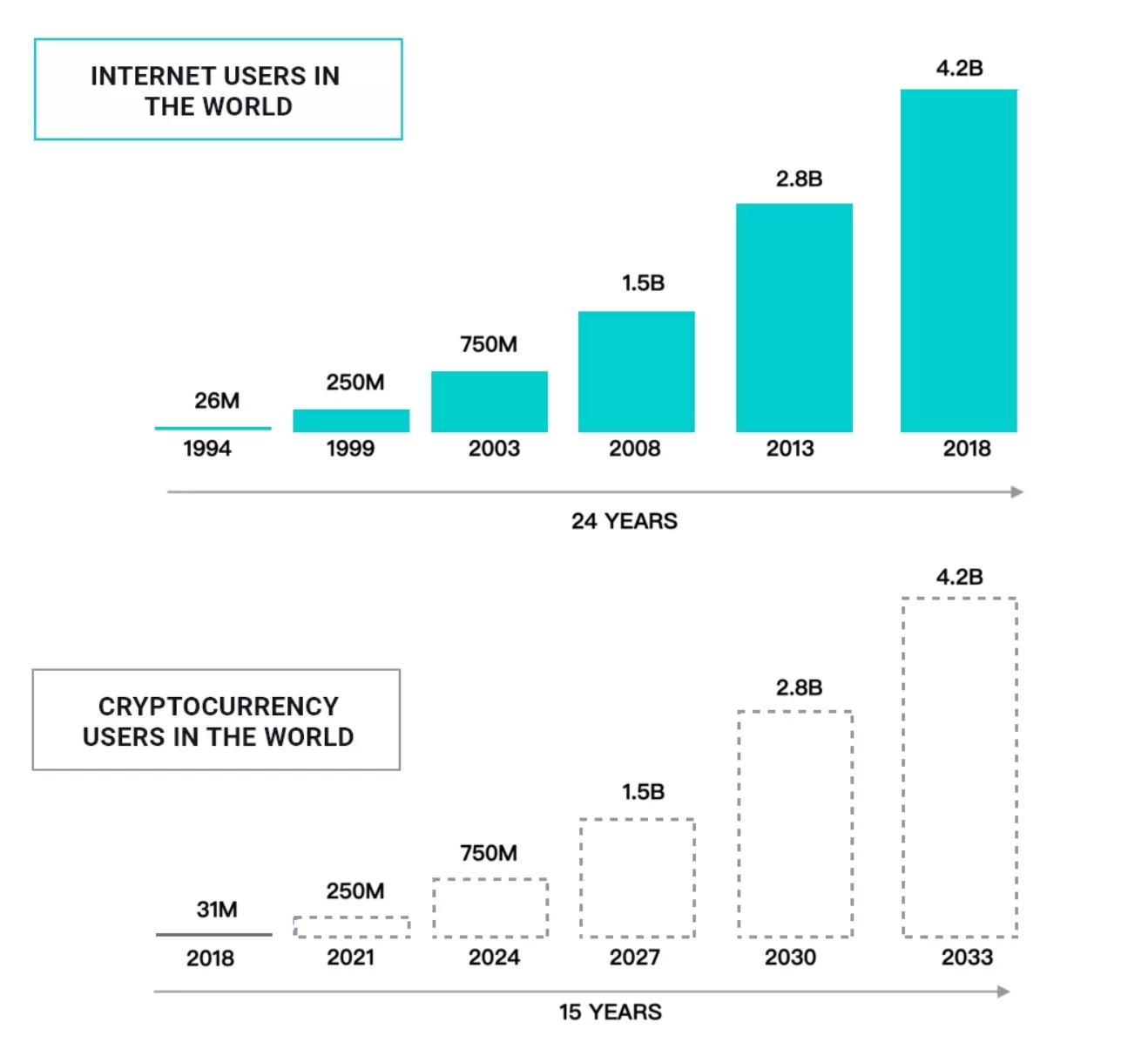
The growth of internet users vs growth projection of cryptocurrency users in the world. Source: Internet vs Blockchain Revolution: Are we in 1994? What to expect next? (Remi Gai)
You are probably still wondering why blockchain — and indeed tokenization — is relevant for real estate. There are several reasons. Real estate properties can be tokenized and it is typically done in two ways. Either the equity of the company owning the property is tokenized, or loans provided by investors to finance the property are tokenized. In the first case, each token refers to one share with regular dividend payouts. In the second case, each token refers to a loan note held by the investor that provided a fraction of the loan. The loan note entitles the investor to regular interest payouts. The digital share further entitles the investor to a share in a potential profit when the property is sold; a loan note often does not give that right.
Real estate represents the biggest single asset class that may be tokenized. Global real estate is around $228 trillion and only 7% of this is available to retail investors. Only 3% of the global population has invested in real estate, but more than 80% views real estate as a good investment. Efficient trading with real estate assets does not exist today and increased liquidity could potentially increase the existing market with a 20–25% liquidity premium.
The real estate industry is plagued by slow, expensive, cumbersome, and paper-based processes relating to the financing and management of projects. Financing is often done by a bank and a few trusted investors able to meet the EUR / USD 100,000 minimum ticket size. Investors are locked in for several years and there is no easy or inexpensive way to sell shares beforehand.
Tokenization of real estate assets solves all of the above problems. Most processes related to financing and ongoing management can be digitized and even automated. Due to the 100x more efficient processes, it becomes possible to manage thousands of investors in a single project and hence to reduce the minimum ticket size down to $1,000 or even $100. This gives the real estate developer access to new types of investors and new sources of capital. With the growth of the total amount of capital, the financing of real estate projects should become easier and less expensive.
Having real estate assets in a tokenized form allows for peer-to-peer trading with instant settlements. Real estate investors will be able to trade their digital shares or loan notes directly with each other in a safe and secure manner. Since the only way a security can exist in digital form outside a bank is as a token on the blockchain, this is the first time direct trading between individuals becomes possible. It only works with blockchain technology.
Last but not least, retail investors can obtain access to real estate investments. Real estate investors can now diversify their portfolios in a manner that is similar to the method wealthy investors have used for hundreds of years. This is also known as the democratization of real estate investments.
Tokenization of real estate enables developers to reduce the cost of financing and ongoing management, to target new types of investors, to more easily finance new projects, and to increase the liquidity of assets.
This is slowly becoming reality in 2020. Some of the last barriers to adoption are being removed. Knowledge and comfort with crypto is becoming more widespread. Software platforms are becoming easier to use to the point where little knowledge of crypto is actually required. Platforms that are tailor-made for real estate tokenization such as the DigiShares white-label platform are becoming better. Pioneers among real estate developers are taking steps to become entrepreneurs in their local region or market segment. All of the different puzzle pieces in the new tokenization ecosystem are slowly falling into place.
Contact us here: info@digishares.io if you are interested in learning more and don’t forget to visit our website to keep up with our progress.
Claus Skaaning, CEO, DigiShares
October 2020
Tokenize Your Real Estate
Many of our current projects are real estate tokenization projects, and for those of you who are specifically interested in real estate tokenization we have created a special page where you can learn about real estate tokenization and how to tokenize your project.
The post Tokenization of Real Estate for Dummies appeared first on crowdfund.direct.
]]>The post Tokenization of Alternative Assets appeared first on crowdfund.direct.
]]>When we think about tokenization of assets the first thing that comes to our mind is the real estate sector. Indeed the biggest interest we are experiencing at DigiShares comes from this field. Till recently investors in this sector had to invest big amounts, especially when they wanted to get an attractive ROI. Nowadays, thanks to the blockchain technology and our security tokens’ issuance platform, investing in real estate becomes more and more accesible to retail investors allowing them to buy even for a little amount of money a fraction of e.g. a big development project.
However, there are many other alternative kinds of investments we’re exploring and working on. The real estate model can be easily transferred to the energy sector. Our tokenization platform can facilitate funding not only of a solar or a wind farm but also e.g. of a biogas or a biomass plant. The holders of such digital shares will be receiving a dividend that reflects the share in the revenue of the energy company which is generated thanks to the tokenized investment project.

When you think big you can also use tokenization to fund big state or public infrastructure projects like e.g. a clinic, a school, a bridge, a highway, heating or telecomunication facilities, pipelines, railways, IT or water infrastructure. The token holders will earn dividends either on the revenue a project gets from end users or on the lease paid by the (local) authorities. Infrastructure long term tends to be less volatile than e.g. equities and provides higher yields.
There’s been also a growing interest in the mining industry. Our solution can help collect funds to open a new mine or tokenize already mined precious metals or diamonds. The investors of such projects will be holding tokens backed by the value of the mined minerals and will be able to trade them accordingly to their value changes.
One of the alternative investments that has been recently booming is fine art. On daily basis we hear about a new auction record and the highest price ever paid for different pieces of art. Thanks to our tokenization platform fine art investors will not have to go out of the house and spend lots of money on a complete piece of art. They will have the opportunity to own fractions of many of them. It will spare them the necessity and costs of keeping it safe, putting all their money in one asset vs. diversification and will give them the access to the most known and valuable pieces of art.
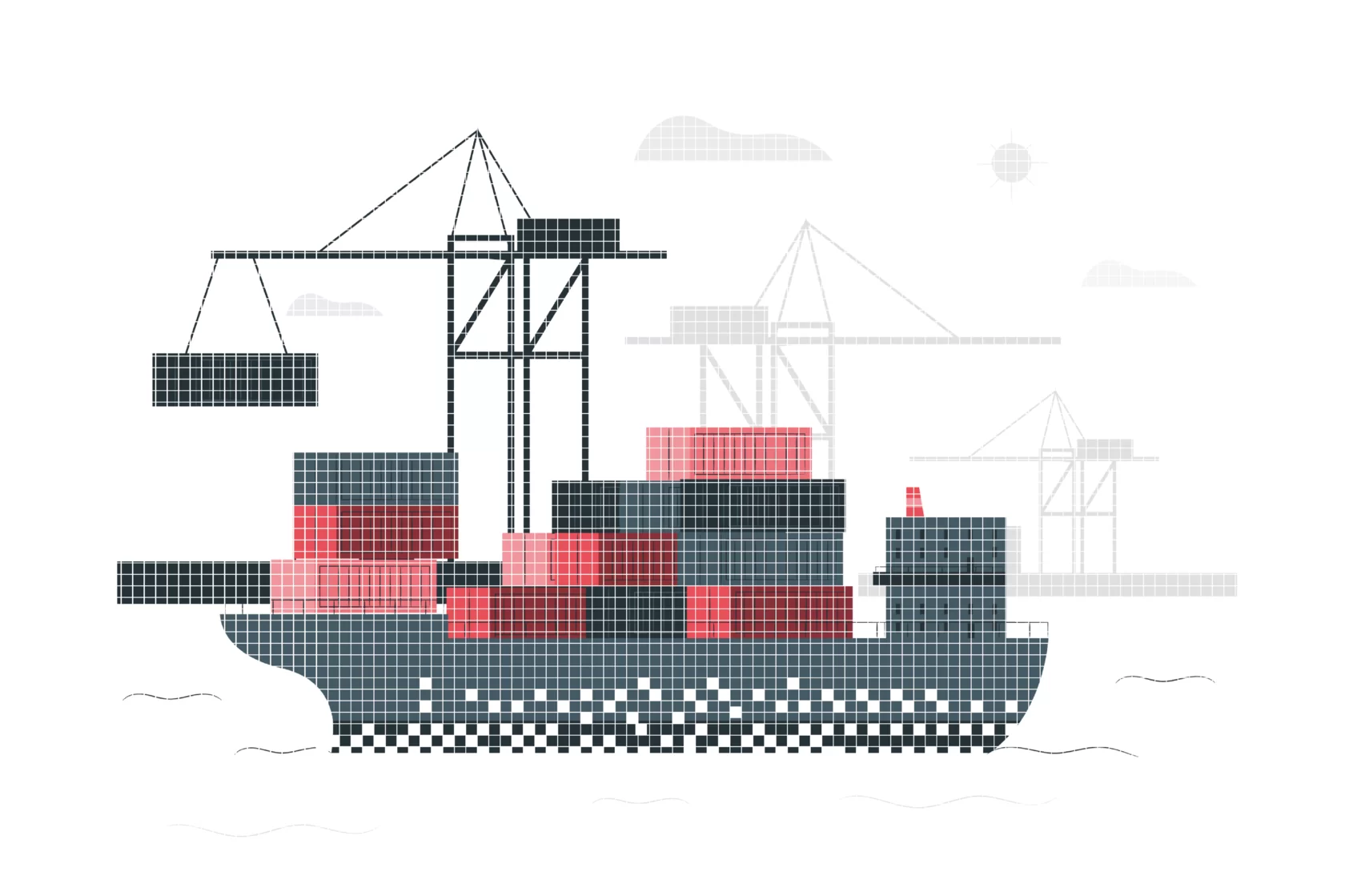
Another great example is the marine shipping sector which carries out most of the world trade flows. In order to buy new vessels and expand their fleets, shippers borrow huge amounts of money. Investors who are not afraid of volatility may be rewarded with attractive dividends if they go for companies that lease their ships to customers at the going market rate, the spot market. Those who prefer lower but more stable and predictable ROI may choose to invest in shipping companies that offer their clients long-term agreements with a fixed price. Tokenization will help shipping companies fund their new vessels in a cheaper, quicker, and more efficient way and will bring them a new stream of retail investors.
If you find these alternative assets relevant to you, or you thought of others that could be tokenized, contact us to arrange an introductory call.
The post Tokenization of Alternative Assets appeared first on crowdfund.direct.
]]>